

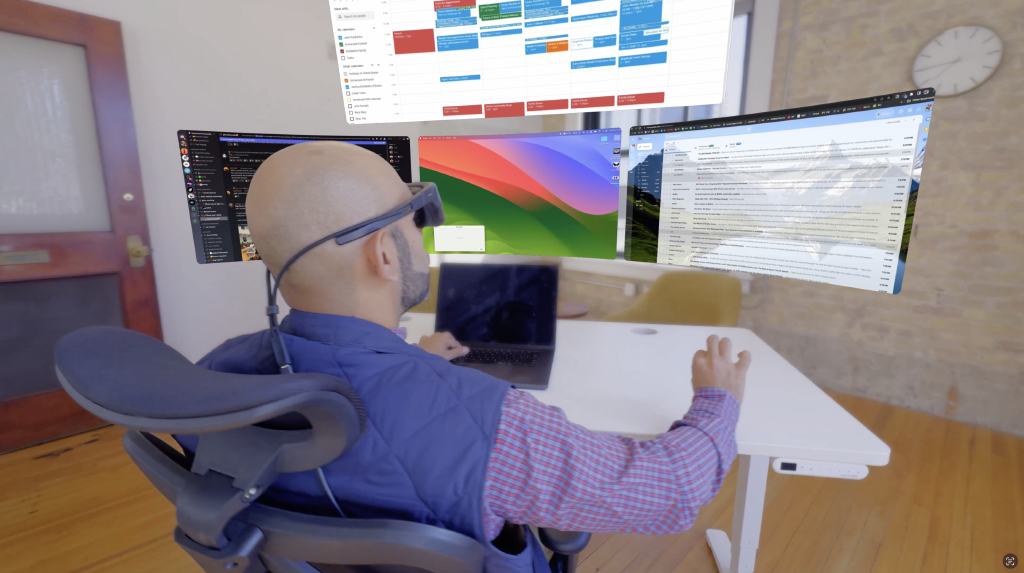
VR Spatials, AR Spatials, And The AI Layer That Makes Them Intelligent

Why VR Spatials and AR Spatials need Spatial AI, Spatial prompts, and analytics to stay aligned.
Virtual and augmented reality are no longer just about pretty graphics. The most interesting work in immersive tech now happens at the intersection of Spatials, Spatial AI, and natural interfaces-where what you see responds intelligently to where you are and what you’re trying to do.
In this new paradigm, VR Spatials and AR Spatials are not just scenes or overlays. They are context-aware agents, tools, and environments that understand the layout of a factory, the flow of a theme park, or the geometry of a city street. They respond to Spatial Prompts in much the same way language models respond to text prompts, but with space and motion in the loop.
This article explores how Spatial AI is transforming VR and AR from content into infrastructure, how platforms like Spatials.ai fit into the picture, and what designers and developers should know when building the next generation of Spatials.
From 3D Scenes to Spatially Intelligent Experiences
Early VR and AR experiences were often static: a 3D model here, a floating UI panel there. Today, the most compelling work treats Spatials as living entities that:
- Understand surfaces, obstacles, and points of interest.
- Track people, devices, and robots over time.
- Adapt behavior based on proximity, gaze, and intent.
Spatial AI powers this shift. By combining SLAM (simultaneous localization and mapping), 3D reconstruction, and semantic understanding, Spatial AI lets VR Spatials and AR Spatials anchor themselves in meaningful ways. A virtual guide can appear at just the right moment, facing the right direction, pointing to the right object-because it understands the space the way a person does.
Spatials.ai focuses on this Spatial intelligence layer: aggregating spatial data, building persistent maps, and providing APIs so developers can attach logic and analytics to Spatials instead of wrestling with low-level geometry.
Spatial Prompts: A New Primitive for Interaction
Text prompts unlocked a new era of creativity for generative AI. Spatial Prompts aim to do the same for Spatial experiences. Instead of writing code, builders and end-users can express intent Spatially:
- Draw a region in a VR twin and say, “Keep this area clear.”
- Stand in a real room and mark a path for visitors to follow in AR.
- Look at a machine and ask, “Show me maintenance history.”
The combination of Spatial context and natural language lets VR Spatials and AR Spatials behave more like collaborators than apps. A Spatial Prompt is richer than text alone: it encodes where you are, what you’re pointing at, and how you’re moving.
By centralizing Spatial Prompts and their outcomes, Spatials.ai can help teams discover which prompts lead to better performance, engagement, or safety-and feed those learnings back into design and optimization.
Designing for VR Spatials
Designing for VR Spatials means treating entire environments as interactive surfaces. Best practices include:
- Contextual guidance: Don’t overload users with instructions; surface them near relevant objects or zones.
- Embodied feedback: Use motion, haptics, and Spatialized audio to reinforce actions and consequences.
- Progressive complexity: Start with simple Spatial Prompts (“Walk this route”) and layer in more advanced interactions as users gain confidence.
Because VR worlds are fully simulated, designers can exaggerate cues, slow down time, or pause scenarios to teach complex skills. Once a workflow is perfected in VR, it can be mirrored in AR Spatials that guide users through the same steps on the real site.
Spatials.ai helps bridge the gap between the fake and the real by ensuring both environments draw from the same Spatial model: the same assets, locations, and semantics.
Designing for AR Spatials
AR Spatials live in the real world, so they’re constrained by lighting, occlusion, hardware limits, and the chaos of everyday life. Effective AR Spatials design leans on:
- Minimalism: Show only what’s needed to move the task forward.
- Anchoring: Attach information to stable reference points-machines, doors, signage-so users can quickly regain context.
- Shared Spatials: Ensure multiple users see consistent Spatials in the same place to enable collaboration.
Here, Spatial AI isn’t just a convenience; it’s a requirement. Without robust tracking and mapping, AR Spatials drift or jitter, eroding trust. With a good Spatial model, AR experiences feel natural: a label stays glued to a machine, a navigation arrow keeps pointing the right way, and a safety warning appears exactly where it matters.
Spatials.ai can provide the persistent Spatial backbone that AR clients tap into, so multiple devices and applications share the same understanding of a site.
The Role of Analytics in Spatial Experiences
Like websites, Spatial experiences need analytics to improve over time. For Spatials, useful signals include:
- Where people dwell or get stuck.
- Which Spatial Prompts they use most often.
- How often VR Spatials training sessions lead to fewer errors in the real world.
- Whether AR Spatials reduce task times or safety incidents.
By treating each Spatial as an entity with a lifecycle-created, deployed, interacted with, retired-teams can iterate systematically. They can A/B test different guidance patterns, layouts, or visual metaphors.
A Spatial intelligence platform such as Spatials.ai can centralize these analytics across VR Spatials and AR Spatials, revealing patterns that wouldn’t be visible from within a single app or device.
Building a Cross-Platform Spatials Strategy
One-off demos are easy; scalable Spatial ecosystems are hard. To avoid getting stuck in prototype purgatory, teams should:
- Define shared Spatial vocabulary: What is a zone, asset, path, or checkpoint across all apps?
- Standardize Spatial Prompts: Establish reusable patterns for safety, training, and operations.
- Invest in a Spatial backbone: Choose a platform, like Spatials.ai, that can manage maps, identities, permissions, and analytics.
- Target both VR and AR: Use VR Spatials for simulation and learning, AR Spatials for execution and feedback.
Ultimately, the most powerful Spatials won’t be tied to one headset or app. They’ll exist as portable Spatial entities-known to robots, headsets, phones, and back-end systems alike-moving with people through space and across devices.
The Future: Spatials as Everyday Infrastructure
As Spatial AI matures, the idea of Spatials will feel less exotic. Just as websites became a default interface for services, Spatials will become the default way to express where and how things should happen in the physical world.
You’ll define emergency routes as Spatial Prompts, not just diagrams. You’ll spin up VR Spatials versions of new stores or factories before you sign the lease. You’ll rely on AR Spatials every day at work, even if you don’t think of them as “AR” anymore.
Behind the scenes, Spatial intelligence platforms like Spatials.ai will keep everything stitched together: maps, identities, policies, and analytics. The result will be a world where digital intelligence is distributed not just across devices, but across the very spaces we inhabit.
Continue exploring the Spatial AI Glossary, the Startup Directory, the Spatial AI Blog, and the Spatial Use Cases to connect these ideas with real deployments.
